Minting volumes for the 50-cent denomination featuring the Kennedy profile traditionally target collector sets.
Manufacturing of these coins follows the standard copper-nickel cladding process.
Inner sections consist of pure copper.
Overall 2024 Half Dollar mintage reached 20,725,000 pieces.
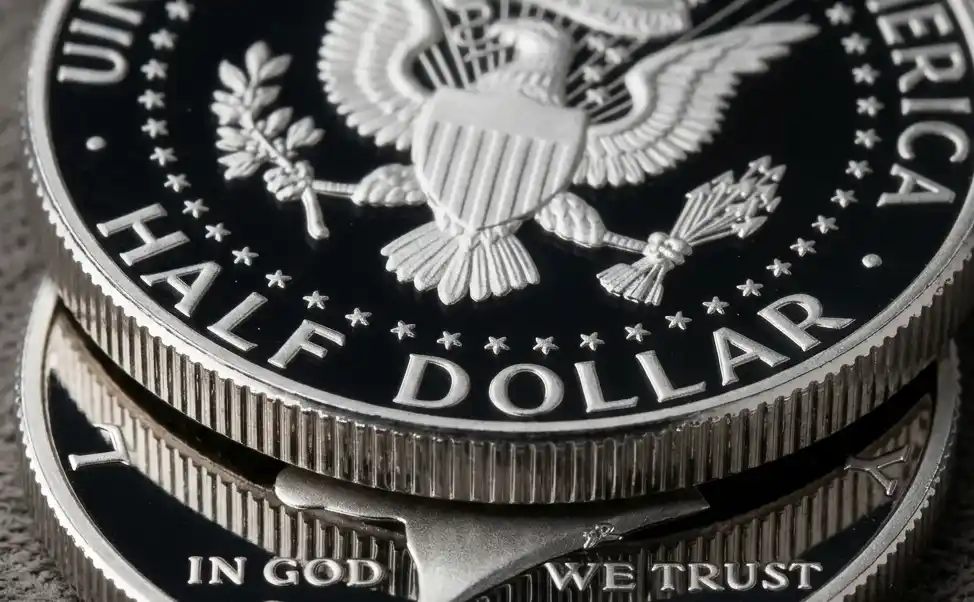
Outer layers involve a mix of copper and nickel at a 75 to 25 ratio.
| Feature | Parameter |
| Total Mass | 11.34 grams |
| Body Diameter | 30.61 millimeters |
| Edge Thickness | 2.15 millimeters |
| Core Material | 100% Copper |
| Coating Material | 75% Copper and 25% Nickel |
| Rim Shape | Reeded, 150 grooves |
Geometric specifications align with the 1964 Coinage Act requirements.
Strict quality control at the pressing stations minimizes the appearance of defective units.
Production Statistics by Mint Branch
Total output distribution involves two primary government facilities.
Philadelphia and Denver produced comparable quantities of units.
Data for 2024 shows volume stabilization following the sharp fluctuations observed in 2021-2023.
- Philadelphia Mint: 10,200,000 units
- Denver Mint: 10,100,000 units
- San Francisco Mint: 425,000 units
Production decreases relative to the ten-year annual average sit at 12%.
Price Dynamics and Market Indicators
Market value for 2024 coins shows steady growth on the secondary market.
Initial sales through government channels occurred at a fixed price point.
Investment potential depends on the preservation state of the surface.
Price change dynamics over the recent period: 2024 (issue) → $1.50 per unit 2025 (monitoring) → $2.10 per unit 2026 (current period) → $2.85 per unit
Annual market value growth averages 45% for uncirculated specimens.
Record auction prices for top-tier preservation categories:
- MS67 (professional certification) — $850
- MS68 (professional certification) — $1,650
- Silver version from Proof set — $140
Value increases stem from limited availability in perfect condition.
Preservation State and Classification
Striking quality for 2024 is rated as high by industry experts.
Mechanical damage occurs mainly during bulk transportation in bags.
Absence of contact marks on the president’s cheek increases the lot price threefold.
Factors reducing the coin price:
- Dark oxidation spots on the copper
- Scratches on the coin fields
- Vague relief on the hair details
- Dents on the rim
Presence of a bright mint luster is a requirement for the MS65 grade and higher.
Expert examinations identify flaws under the coin identifier app free.
San Francisco Special Issue Features
Coins bearing the S mark are produced exclusively in a mirror-like finish.
Proof technology involves a double strike of the die on a polished blank.
| Coin Type | Mintage | Price in 2026 |
| Standard Proof | 350,000 | $15.50 |
| Silver Proof 99% | 75,000 | $110.00 |
Mass for the silver version stands at 12.50 grams.
Utilization of fine silver removes the need for a nickel cladding.
Silver set values correlate with global precious metal pricing.
Cause and Effect of Market Demand
Market conditions in 2026 confirm the hypothesis regarding 2024 scarcity.
Low mintage → Increased dealer interest → Rising auction prices
Ending mass minting for the banking sector during 2002-2020 created delayed demand.
Returning to circulation strikes in 2021 temporarily saturated the market.
Subsequent production plan reductions in 2024 triggered an upward price correction.
Share of 2024 coins in the total volume of half dollars in circulation does not exceed 1%.
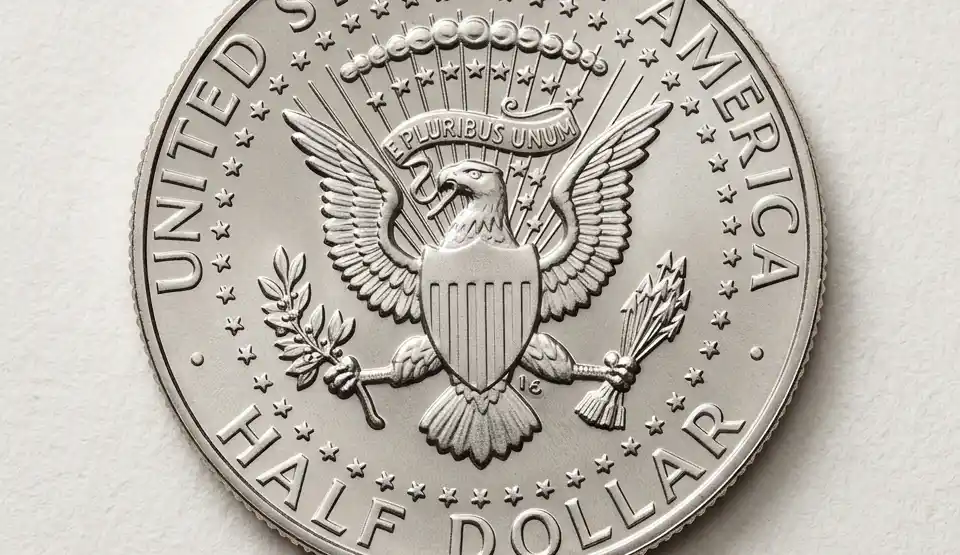
Comparative Analysis with Previous Periods
Mintage for 2024 significantly trails the levels seen in the early 2000s.
Comparison of annual volumes (millions of units):
- 2001 — 42.1
- 2010 — 3.5
- 2021 — 15.1
- 2024 — 20.7
Despite growth compared to 2010, the current volume remains below the historical norm.
Percentage ratio of Philadelphia to Denver output stands at 50.2 to 49.8.
Balanced distribution reduces the risk of regional shortages from a single mint.
Mint Errors and Rare Varieties
Numismatic value for 2024 coins rises when production errors are identified.
Double-struck images are considered the most valuable by collectors and can be detected with the coin identification.
Types of confirmed errors: Double date on the back Missing nickel layer on one side Blank planchet shift during strike, die cracks on the front
A coin with a 15% shift is valued at $220.
Total absence of coating increases the price to $450 per unit.
Storage Conditions and Asset Safety
Chemical stability of the metal mix depends on the external environments.
Copper patina processes lead to color shifts from gold to brown.
Conservation rules for coins: Use of acid-free albums, maintaining humidity levels below 40% Avoiding direct skin contact Storage in plastic capsules
Violating storage protocols reduces the coin grade by 2-3 points over five years.
Grade reduction → Loss of 60% potential profit during resale